
Fandom culture
On fandom economies and dynamics, resistance and in defense of fan fiction.

In a world of social media, everything has a fandom, so much so that the word has almost lost its meaning. Technically a “subcultural group made up of media fans”, those within fandoms would describe them not as a series of categorised, alienated sects, but as a massive and flowing number of people occupying the same space to feel the same things: comfort, solidarity, and gratification.
The idea of ‘fandom’ transgresses the socially accepted stereotype of nerdy, white, middle-class boys without many friends; in fact, you’re probably in one yourself - Swifties, Gooners, ARMY, Tories, Hamilstans - whether it’s a celebrity, sports club, political party, tv show or fictional universe, there is always a fandom behind a media object.
It's not hard to be in a fandom; there is no set initiation, and no necessary level of participation. They support hundreds of millions of people, 47% say that a connection to their fandom is a core part of their identity, and many describe the communities as literally saving their lives. This was especially apparent during the pandemic, when people gravitated back to nostalgic franchises to relive the comfort and joy of that media.
In this essay, I will be focusing on fandoms specifically derived from fictional media such as films, books and TV shows, exploring the dynamics of fandoms and the nature of the transformative works produced by (especially female) fans.
“Fandoms [are a] ‘gift economy’, based not on money or explicit exchanges of goods or services, but on giving, receiving and reciprocating.” (Turk)
Fandoms as economies is a fascinating and wholly possible concept: there is a constant, subconscious transaction between someone commenting on another’s art, volunteering to edit a fanfic, suggesting prompts, organising exchanges, planning conventions or creating websites. A fandom as a whole can be categorised as a ‘participation’ culture; a system “not just of reciprocal giving but of circular giving” (Turk 2014).
Jenkins’s states that fanfics are “a kind of apprenticeship”, evidenced by a study on fanfiction.net researching writer’s overall language ability that showed “accumulating roughly 650 reviews predicts the same increase in lexical diversity as one year of maturation.” This improvement of an author’s talents is usually to other users who frequently comment, leave kudos, or volunteer as editors/beta readers. This is popular in the Sherlock fandom, where authors would rely on ‘Britpick’ editors who would correct Americanised spelling and customs to suit the classically England-set fanfics.
Each hit, or kudos (measurements of ‘views’ or ‘likes’ on AO3) can inspire a fanfic author to publish another work, which would inspire another reader to start producing fan art, this art could inspire another fanfic, which a new fan loves so much they set up a fan page on Instagram, making edits, these edits are to Taylor Swift songs, so intercept Swifties who then join the fandom: there is a constant and unstoppable spread of creative processes headed by the free culture of fandoms.
There are levels within a fandom of - for lack of better work - geekiness, mostly ruled by different fans’ personal opinion. For example, a fan who goes to a fan convention might consider themselves geekier than a fan who only buys and reads the comic, but less geeky than a fan who cosplays. That fan who cosplays might consider themselves geekier than fanfiction readers, but less geeky than fanfiction writers.
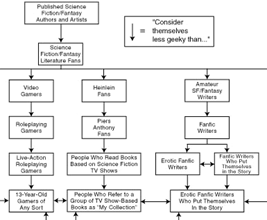
“Geek Hierarchy” a flow chart created by Lore Sjoberg purporting to delineate the general rankings of what makes a fan more or less geeky.
“Fandom’s very existence represents a critique of conventional forms of consumer culture.” (Jenkins, 2009)
Archive of Our Own, or AO3 (The title inspired by A Room of One’s Own, by Virginia Woolfe), is a Hugo-Award winning site for transformative works, which holds over 13.5 million fanfics across 67,000 fandoms. Initially started in 2008, it took over from FanLib, a website designed by men with the intention of monetizing fanfiction. Alternately AO3 is a “female-dominated, open-source coding project with a women-led development team” (Professor Coppa, founder). It’s run by bi-annual fundraising harbouring donations up to $620,000 (September 2023), which goes towards server hosting and maintenance. The site itself is run and managed by millions of dollars’ worth of volunteer labour. “Tag wranglers” manage the site’s search system, for example, allowing it to understand that “mermaid” “merman” and “merfolk” are constituents of the “merpeople” tag, as well as pairing ship names and their characters’ slash search, e.g WolfStar and Remus Lupin/Sirius Black, or BlackHill and Maria Hill/Natasha Romanov. Thousands more help translate fan works, making them more accessible globally. At the moment, translators are working specifically into Mandarin, resisting the turn of increasing restriction on free speech in China.
As well as combatting censorship of literature, fanfiction provides sex education in a social environment when the minor provision in (mostly US) schools is heterosexual, boarding on celibacy. Fanfics portray sexual as well as romantic intimacy, addressing issues of consent, sexual safety, communication and sexual trauma better and in far more depth than commercial offerings.
“Women often join fandoms because they provide a space for people to understand their identities and express themselves.” (Dandrow)
‘Curative’ activities, like collecting merchandise or memorizing trivia is associated with male fans, often as a method of policing other fans, especially women; while the vast majority of fanfiction writers are women, hence a naturally feminist subculture that transgresses or subverts the original narrative.
Transformative actions, such as fanfiction, fan art, fan videos, give fans the power to take narratives and characters they are emotionally invested in and translate them more directly to their “feminine, feminist and/or queer investments and desires”. It’s not coincidental that the modern age of fanfiction coincided with the women’s liberation movement. Fan fiction is an opportunity for women to bring female experiences into their favourite media, which are generally written by and about men, giving them a chance to challenge the norms of gender and sexuality.
Seeking a fandom is first and foremost seeking a community who will respect you for who you are, not always a thing women can find in their daily lives.
Although 80% of users on AO3 are women, the proportion of works and ships are predominantly centred around men and male pairings. This is true of most fanfiction sites (e.g fanfiction.net and Wattpad), however AO3 user centreoftheselights posts annual ship stats:


Table of top ships of all time on Archive of Our Own, centreoftheselights
In 2024, of top 100 ships, 63 are M/M, while only 5 are F/F. In the stats of all time, this inequality increases to 70 M/M, and 5 F/F. The top spot is held by Castiel/Dean Winchester from Supernatural (2005) with 105,322 works, while the top F/F ship is ranked 37th, Kara Danvers/Lena Luther from Supergirl (2015) with 20,322 works.
Within these statistics we can find many trends: the majority of popular pairings are M/M. F/M and F/F pairing are far more likely to be canon and also more likely to be tagged as side pairings or background relationships.
The lack of female pairings (F/F, known as femslash) is fuelled by so many components: namely, a lack of female characters and relationships in the source material gives fanfic authors nothing to work with. There is also a lack of favoured dynamics, those which are more likely to be shipped such as rivals and close friendships are more likely to exist between male characters. The media is usually compulsively heterosexual, with female characters already canonically paired with a man, and misogynistic - female characters are separated from female characters who are not family members. Additionally, fan fiction writers can struggle writing about female characters as it forces them to confront issues like body image, everyday sexism and sexuality which they might find uncomfortable. Finally, straight women want hot guys - although a majority of the users are LGBTQ+, a majority of female writers are straight and write stories with their own preferences: men.
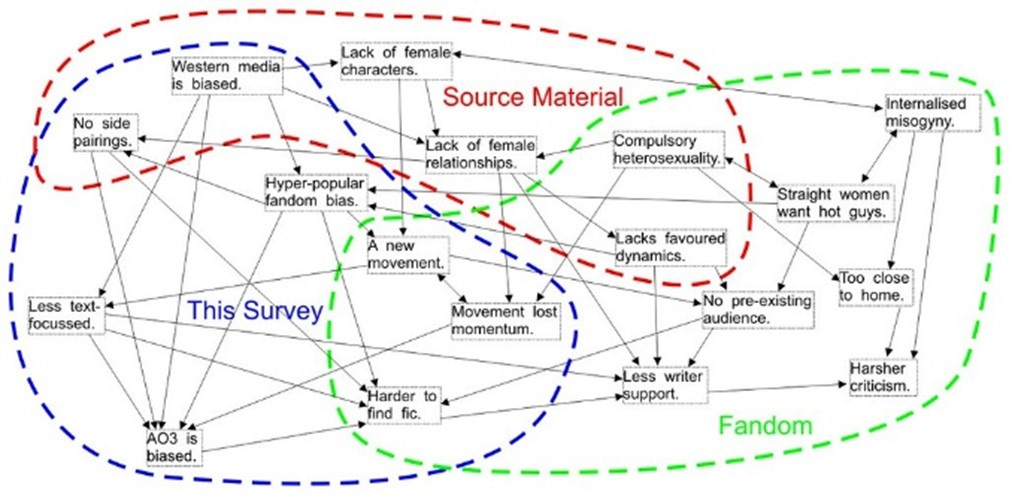
Graph created by centreoftheselights illustrating the possible explanations for a lack of femslash and how they might interlink.
“Fanfiction provide opportunities for fans to enhance the lives of characters they see themselves in, subconsciously imagining a better future for themselves.”
Fandoms are awe-inspiringly massive, All the young dudes by MsKingBean89, the epic, globally renowned Marauders fan fiction has amassed over 15.5 million hits on AO3, which is more than the population of Guinea, the 75th most populous country in the world. At over 188 chapters and 526,000 words, ATYD has its own Goodreads page, ranked 4.87 stars, readers claiming:
“As far as I’m concerned, this is neither a fanfiction nor a prequel. It’s the main thing.”
“this was the length of war and peace so it counts ok” (and it pretty much is.)
The Marauders fandom is a fascinating example of fans’ ability to create as a community, regardless of being split by languages, continents and time zones. A simple line in the entire series of Harry Potter has been almost infinitely extrapolated into its own universe, effectively a fandom grown from scratch. The relationship between the Harry Potter fandom and Marauders fandom is comparable to the divide between the Loki and MCU fandoms; they’re derived from the same source material, yet fans can expand on a small aspect of source material and show their affections for this specific element.
The enormous audience on sites for fanfiction has managed to terrify AO3 itself, the site tweeting:
“The Archive recorded 68.6 million page views on Sunday, which is a new weekend high. 448 million page views for the whole week, which is 150 million more than the same time last year. (Are you all okay?)”
Pro tip: never assume the fan fic readers are okay.
ATYD might be the most famous, but it’s certainly not the longest on AO3, that trophy belongs to “The Loud House: revamped” at 16,000,000 words. For comparison, the longest book in the word is Marcel Proust’s “Remembrance of things past” with only 1,500,000 words.
All fanfiction is free, since they are derivative works, they cannot be officially published due to copyright. AO3 can be used anonymously as a guest or account user, and fanfiction is free to post without screening or restrictions - astonishing for the fact that it can provide significant opportunities for personal, social and literary development.
What's so wonderful about fanfiction specifically is that it’s easy to read (unless you’re on 294k slow burn sci-fi AUs at 3am). To make room for new characters, to remember their names, and their traits, their backstories and unique nuances is exhausting. You already know that you consuming this media world is worth the investment of your time and energy, so if you want to read something new, but not that new, just try sticking your favourite couple in a coffee shop, or ask yourself what if x had happened?
There are people literally writing books perfectly accessible for free online, taking comments and ideas by actively interacting with their audience. In a world where you pay for books, paper and pens - even water – here, you need a phone and some Wi-Fi and there are novels about your favourite characters for nothing. (Everyone say thank you to the local fanfic writer.)
“It’s far from a utopian entity, it has its own elements of toxicity.” (Govocek)
There are two very generalised images of fans in societies mind: the ‘obsessed loner’, who enjoys collecting memorabilia to store in their basement and methodically clean 8 times a day, and the ‘frenzied fan’ representing the screaming and crying teenage crowd, or the rioting sports fan. Both of these characterisations result in stigmatising and alienating fandom culture, easily stereotyping their participants.
It is ignorant to blatantly ignore the faults within fandoms. They are inherently echo chambers, so toxicity and single-mindedness can and does foster, as well as criticism erupting from a lack of ethnic, disability and sexuality diversity.
Users can get aggressively controlling over their own specific head canons, or citing those head canons as fanon or canon, while those who publish works very separated from canon, like self-insert character (y/n), character/reader or AUs can face bullying for their own personal, creative decisions.
Fandoms are spaces that are socially stigmatised into little caves of youth gamers and socially alienated men, divided by this us/them dynamic (possibly derived as fan is short of ‘fanatic’ conjuring an image of a crazed and uncontrollable person) when instead they’re thriving economies designed to bring joy, curiosity and community.
A person who is passionate about an academic subject can be just as passionate about that subject as a member of a fandom is about their media object, yet society views academia as a rational interest held by higher class members of society. The passion of fandoms is opposingly seen as an emotional obsession held by less educated lower-class members of society, which therefore is dangerous.
When Archive of Our Own won the Hugo Award for Best Related Work in 2019 (one, if not the most renowned awards in sci-fi and fiction) one of the founders Naomi Novik accepted the award and invited anyone in the audience who was part of the AO3 community to stand up and accept the award with her. It was a defining moment for fandom culture; in a room full of professional authors, editors, artists and journalists about a third stood up. It demonstrated that fans are not just passive recipients of work, but creatives and creators in their own lives, and second, it destroyed a stereotype of fanfic authors as young amateurs, yes, they are too, but they are also full-time workers in the industry.
I’ve been consciously involved in fandoms for 4 years, and I can sincerely say that if it hasn’t saved my life, it’s certainly changed it. I can speak to the community element first hand; my editor is American, Beta reader Australian, and a user who’s been commenting for 2 years is Spanish, and learnt English through “reading pure fanfics… not even kidding.”. Culture of fandoms is such that my writing a piece of work with representation I never got growing up helped someone else learn a language.
Fandoms are universes within universes; profound social and creative spaces where people can enjoy the media they love, explore their own identities and learn skills like coding, languages and writing. Yes, there can be toxicity and gatekeeping, but ultimately, they are there for people to find and be themselves, with others can relate to the same emotions, experiences or questions. We are all searching for a community, for the ‘found family’ trope within our own lives, and maybe you never expected it to come in the form of an online fandom (to be honest, I didn’t either) but if I’ve learnt one thing from years in fandoms it’s that the first rule is to welcome everyone in.
So go, find yourself a universe.